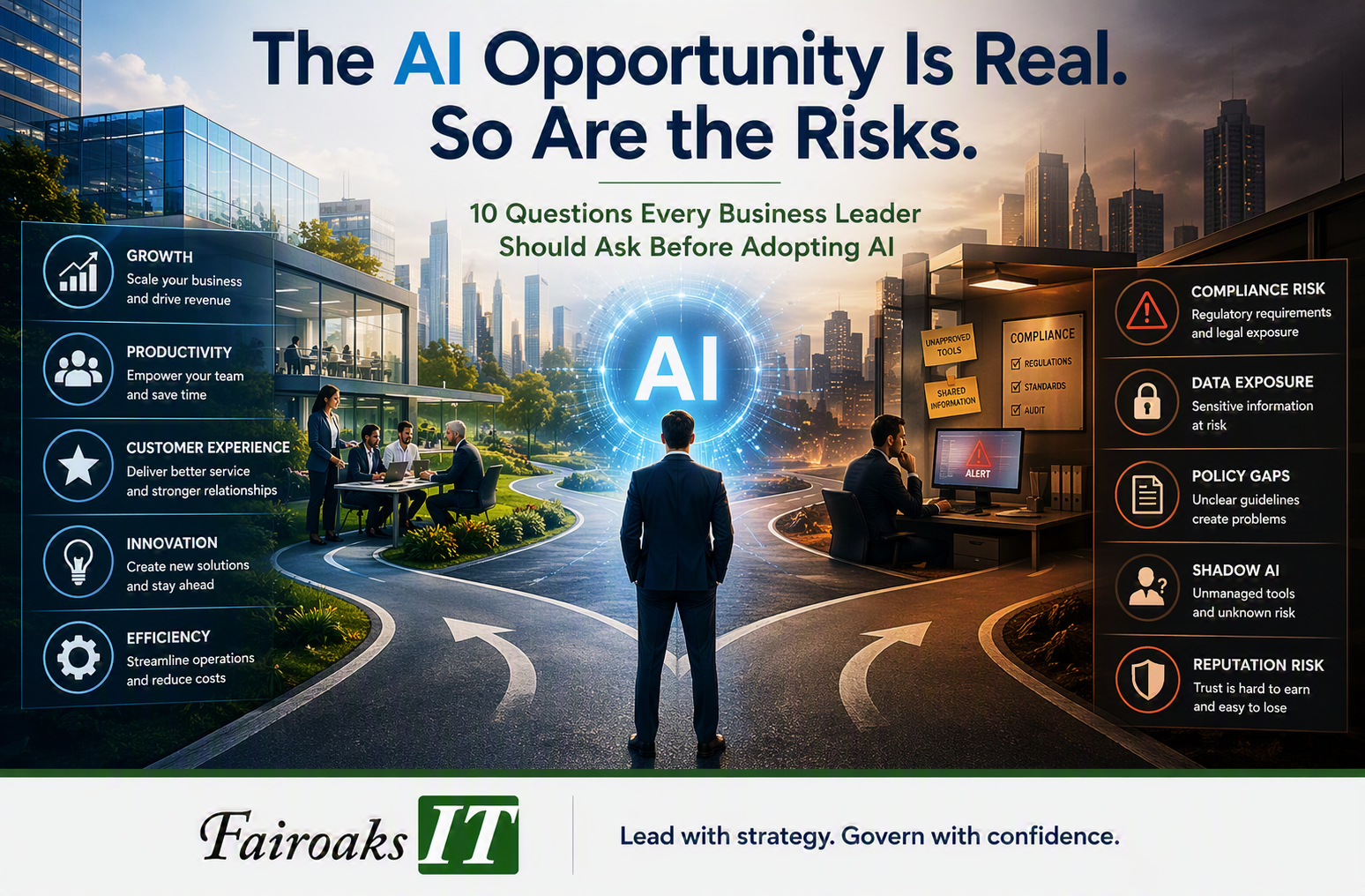
Chances are you already have AI in your business. You need to be asking yourself these 10 critical questions if you want to use it effectively without creating unnecessary business risk.
Here are the questions every business owner, executive, and IT leader should be asking right now.
1. What business problems are we actually trying to solve with AI?
Before evaluating tools, identify the outcomes you want to achieve:
- Increased employee productivity?
- Improved customer experience?
- Faster decision-making?
- Reduced operating costs?
AI should support business objectives, not become a technology project looking for a purpose.
2. Where is AI already being used in our organization?
Many companies discover employees are already using ChatGPT, Copilot, Gemini, Claude, or other AI tools without formal approval.
You can't manage what you can't see.
3. What company data are employees entering into AI systems?
One of the biggest risks isn't malicious behavior—it's well-intentioned employees sharing:
- Customer information
- Financial data
- Contracts
- Pricing information
- Intellectual property
Leaders need clear guidelines on what information may and may not be shared.
4. Do we have an AI usage policy?
Most companies have acceptable-use policies for email, internet access, and cybersecurity.
Few have established rules for AI.
Employees need clear direction on:
- Approved tools
- Appropriate use cases
- Data handling requirements
- Review and approval expectations
5. How do we verify that AI-generated information is accurate?
AI is incredibly useful, but it can be confidently wrong.
Before AI-generated content influences:
- Sales proposals
- Financial decisions
- Customer communications
- Contracts
- Operational processes
someone should be responsible for validating its accuracy.
6. Who is accountable for decisions influenced by AI?
AI can support decision-making, but it shouldn't replace accountability.
Business leaders must determine:
- Who owns AI governance?
- Who approves AI initiatives?
- Who monitors compliance?
- Who manages risk?
Ultimately, people—not software—remain responsible for outcomes.
7. Could AI create compliance, legal, or regulatory concerns?
Industries with regulatory requirements face additional questions:
- How is data protected?
- Can decisions be audited?
- Are records retained correctly?
- Are privacy obligations being met?
Compliance issues created today can become expensive problems later.
8. How would an AI-related mistake impact our business?
Every executive team should ask:
"What is the worst-case scenario?"
Examples include:
- Disclosure of confidential information
- Brand damage from inaccurate communications
- Incorrect business decisions
- Customer trust issues
- Legal liability
Understanding potential consequences helps determine appropriate safeguards.
9. Are we preparing our employees to use AI effectively?
The companies receiving the greatest benefit from AI aren't simply buying software.
They're investing in:
- Employee training
- Business process changes
- Governance frameworks
- Continuous education
AI literacy is becoming a competitive advantage.
10. Are we building AI as a strategic advantage—or creating future risk?
The organizations that succeed with AI won't necessarily be the first adopters.
They'll be the organizations that:
- Establish clear policies
- Manage data responsibly
- Train employees effectively
- Align AI with business goals
The goal isn't to move fastest.
The goal is to move intelligently.